Have you ever gazed up at the night sky and marveled at the bright, silvery glow of our closest celestial neighbor? It is a sight that has inspired poets, astronomers, and dreamers for thousands of years. But when you look past the romance and the mythology, a fundamental scientific question remains: Why does the moon shine so brightly in the dark expanse of space? Unlike a light bulb or a star, our lunar companion does not possess the internal mechanisms required to generate its own illumination. Instead, it relies on a spectacular cosmic partnership. In this comprehensive guide, we will explore the fascinating science of lunar illumination, dive into the mechanics of its changing phases, and uncover the truth behind the glowing orb that lights up our night sky.
This article provides a deep dive into the astronomical phenomenon of lunar illumination. You will learn the scientific reality that the moon does not create its own light but acts as a massive mirror reflecting the sun’s rays. We will explore the eight distinct lunar phases, examine how the moon’s rocky, volcanic surface impacts its brightness, and debunk long-standing myths like the “dark side of the moon.” By the end of this guide, you will have a complete understanding of lunar mechanics, armed with expert observation tips and fascinating facts to share during your next stargazing adventure.
The Science Behind Moonlight
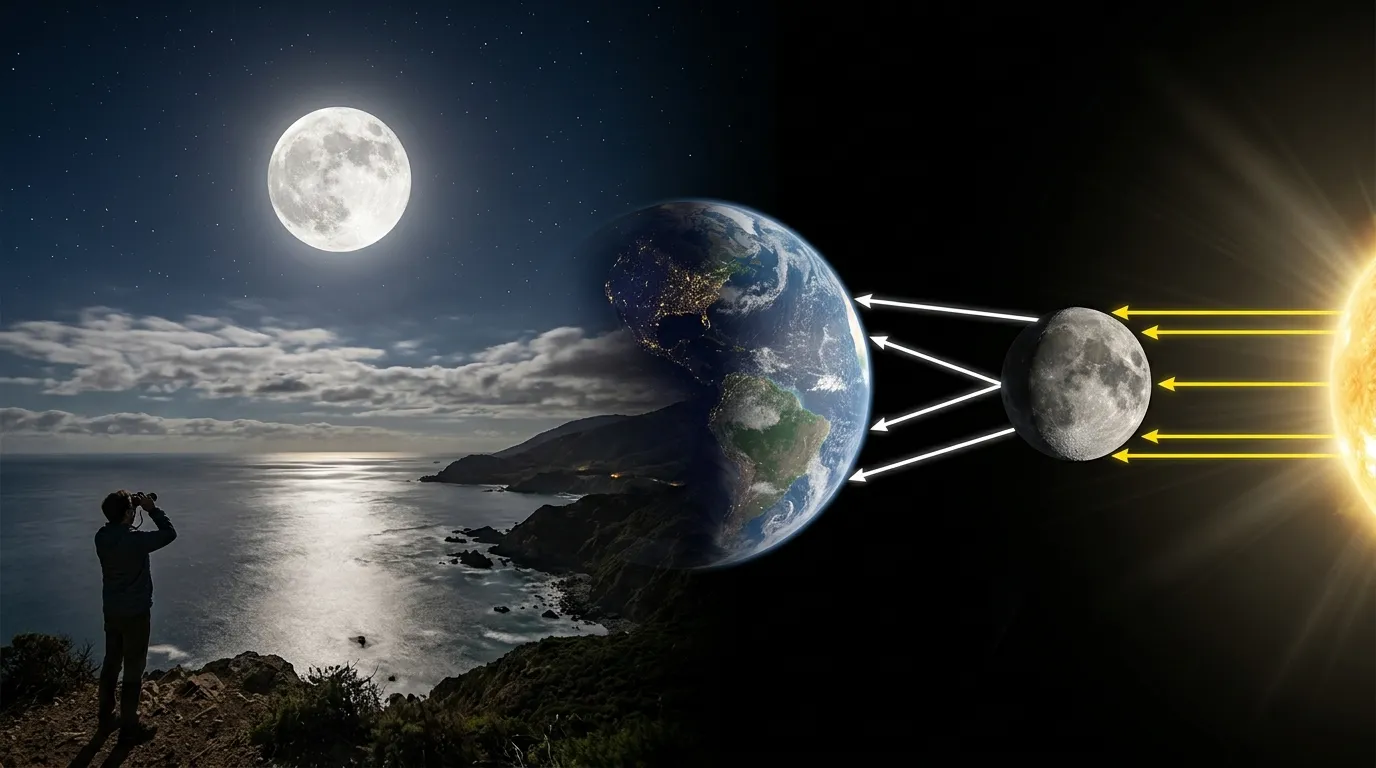
To understand the brilliant glow in our night sky, we must first dispel the most common illusion about our lunar neighbor. The moon does not emit a single photon of its own visible light. Instead, the phenomenon we call moonlight is actually just sunlight that has traveled across the solar system, hit the rocky lunar landscape, and bounced back toward Earth.
Think of the moon as a giant, spherical mirror suspended in the vacuum of space. While a household mirror is made of highly polished glass and metal that reflects almost all the light that hits it, the moon is made of dark, dusty rock. Even so, the sheer volume of sunlight blasting the lunar sphere is so immense that even a small percentage of reflected light is enough to illuminate our terrestrial nights. When you step outside and walk under the glow of a full moon, you are literally walking in second-hand sunlight.
This process of lunar reflection is a constant cosmic dance. The sun is essentially a gigantic nuclear fusion reactor, radiating energy in all directions. A portion of that energy strikes the moon. Because the moon lacks an atmosphere to scatter or absorb this incoming radiation, the light hits the barren rock and dust directly. The light then scatters off the uneven terrain, and a fraction of those photons travel the 238,900 miles back to our eyes here on Earth.
According to experts at NASA, the moon only reflects about 10 percent of the sunlight that hits it. If it were completely covered in ice, it would be blindingly bright. However, because it is so close to Earth relative to other celestial bodies, that 10 percent reflection is more than enough to dominate our night sky, outshining every other star and planet visible to the naked eye.
Phases of the Moon and Their Visual Impact

As the moon orbits our planet, its position relative to the Earth and the sun constantly changes. This orbital geometry is what creates the shifting phases of the moon that we observe throughout the month. At any given moment, exactly half of the moon is illuminated by the sun (lunar day) while the other half is shrouded in shadow (lunar night). The phases simply describe how much of that sunlit half is visible from our vantage point on Earth.
The lunar cycle takes about 29.5 days to complete. During this time, the moon transitions through eight distinct stages:
- New Moon: The moon is positioned directly between the Earth and the sun. The illuminated half is facing entirely away from us, making the moon virtually invisible in the sky.
- Waxing Crescent: As the moon moves along its orbit, a tiny sliver of the sunlit side becomes visible, forming a delicate crescent shape on the right side.
- First Quarter: The moon has traveled one-quarter of the way through its orbit. We now see exactly half of the sunlit side, which looks like a semi-circle.
- Waxing Gibbous: More than half of the moon is illuminated, but it is not quite full yet. The illuminated portion continues to grow (“wax”) day by day.
- Full Moon: The Earth is now positioned roughly between the sun and the moon. The entire sunlit half of the moon is facing us, creating a brilliant, fully illuminated circle.
- Waning Gibbous: After the full moon, the visible illuminated portion begins to shrink (“wane”). It is still more than half full, but the brightness is visibly decreasing.
- Third Quarter (Last Quarter): The moon has completed three-quarters of its orbit. We again see exactly half of the sunlit side, but this time it is the opposite half from the First Quarter.
- Waning Crescent: Only a final sliver of light remains visible on the left side before the moon disappears entirely back into the New Moon phase, starting the cycle all over again.
Understanding the phases of the moon is crucial for astronomers, navigators, and nature enthusiasts. The varying amount of illuminated surface dictates how much light reaches Earth, drastically altering the visibility of stars and deep-space objects in the night sky.
The Moon’s Surface and Reflection Mechanics

To fully grasp the mechanics of lunar reflection, we must examine what the moon is actually made of. If you were to look at the moon through a high-powered telescope, you would see a rugged, battered landscape. The moon’s surface is covered in a layer of fine, powdery dust and rocky debris known as regolith. This material is primarily the result of billions of years of asteroid and meteorite impacts pulverizing the lunar crust.
Astronomers use a term called “albedo” to describe how much light a celestial body reflects. Albedo is measured on a scale from 0 to 1, where 0 is a perfect black surface that absorbs all light, and 1 is a perfect mirror that reflects all light. The moon’s average albedo is about 0.12. This means it reflects only 12 percent of the sunlight it receives, absorbing the remaining 88 percent.
Why is the albedo so low? The answer lies in the composition of the moon’s surface. When you look up at a full moon, you will notice large, dark patches and brighter, lighter regions. The dark patches are known as “maria” (Latin for seas). These are vast, ancient plains of hardened basaltic lava from long-dead volcanoes. Basalt is a very dark rock, similar to the fresh lava flows you might see in places like Hawaii. Because it is dark, it absorbs most of the light that hits it.
The brighter regions are the lunar highlands. These mountainous areas are older and composed largely of a rock called anorthosite, which is richer in calcium and aluminum, making it lighter in color and more reflective. The contrast between the low-albedo basaltic plains and the higher-albedo highlands is what creates the distinct patterns we see from Earth. Despite being essentially as dark as worn asphalt, the sheer intensity of the sun’s light makes the moon appear as a glowing white orb in the contrast of the pitch-black night sky.
The Indispensable Role of the Sun

Without the sun, the moon would be completely invisible to the human eye. The sun is the absolute powerhouse of our solar system, acting as the sole light source for our planetary neighborhood. It is important to emphasize that the brilliance of the moon is entirely dependent on the strength and stability of solar radiation.
Light from the sun travels at 186,000 miles per second. It takes roughly eight minutes for sunlight to traverse the 93 million miles of open space to reach the moon. Once it hits the lunar dust, it bounces off and takes just about 1.3 seconds to cross the gap between the moon and Earth.
This relationship between the sun, Earth, and moon dictates not just the phases, but also dramatic astronomical events like eclipses. A lunar eclipse occurs when the Earth passes exactly between the sun and a full moon, casting its shadow over the lunar surface. Even during a total lunar eclipse, the moon rarely goes completely dark. Instead, it often takes on a deep, blood-red hue. This happens because Earth’s atmosphere acts like a lens, bending and filtering the sunlight so that only the longer red wavelengths reach the moon. It is a stunning visual reminder that the sun’s light is always the driving force behind lunar visibility.
Common Misconceptions About the Moon
Because the moon has been an object of human fascination since the dawn of our species, it is surrounded by myths, legends, and scientific misunderstandings. Let us address and debunk some of the most persistent misconceptions.
Misconception 1: The Moon Produces Its Own Light
As we have thoroughly established, the moon does not glow from within. Unlike stars, which fuse hydrogen into helium to create immense energy and light, the moon is a cold, geologically inactive sphere of rock. Every ounce of its glow is purely reflected sunlight.
Misconception 2: The “Dark Side of the Moon”
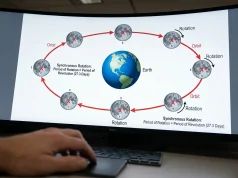
Pop culture and music have popularized the concept of the “dark side of the moon,” implying there is a region perpetually shrouded in pitch blackness. This is scientifically false. Because the moon rotates on its axis at the exact same rate that it orbits the Earth (a phenomenon called tidal locking), we always see the same side. However, the side facing away from us still receives a full two weeks of brilliant sunlight during every lunar cycle. A more accurate term is the “far side of the moon.”
Misconception 3: The Moon is White or Yellow
From our perspective on Earth, the moon often looks bright white, pale yellow, or even deep orange. However, this is an optical illusion caused by Earth’s atmosphere scattering the light, combined with the bright contrast against the dark sky. If you were standing on the moon in a spacesuit, the ground beneath your feet would look like a dull, charcoal gray.
Misconception 4: The Man in the Moon
Across different cultures, people have looked at the dark and light patches of the moon and seen shapes—a face, a rabbit, a toad. This is a psychological phenomenon called pareidolia, where the human brain attempts to find meaningful patterns in random visual data. The “man in the moon” is simply a collection of ancient, overlapping volcanic craters.
Comparison Table: Albedo in the Solar System
To truly understand how reflective the moon is, it helps to compare it to other objects in our solar system. As mentioned earlier, albedo is the measure of reflectivity. Let us look at how the moon stacks up against its neighbors.
|
Celestial Body |
Average Albedo |
Surface Type |
Visual Brightness |
|---|---|---|---|
|
Enceladus (Saturn’s Moon) |
0.81 |
Fresh, clean ice |
Extremely Bright |
|
Venus |
0.75 |
Thick sulfuric acid clouds |
Very Bright |
|
Earth |
0.30 |
Water, clouds, landmasses |
Moderately Bright |
|
Mars |
0.15 |
Iron oxide dust (Rust) |
Dimly Bright |
|
The Moon |
0.12 |
Dark basalt and rocky dust |
Dim (Like worn asphalt) |
As you can see, the moon is actually one of the least reflective major bodies in our inner solar system. Venus appears incredibly bright in our evening sky because its thick cloud cover reflects a massive 75 percent of sunlight. The moon only appears brighter than Venus to us because it is millions of miles closer to Earth.
Common Mistakes to Avoid When Observing the Moon
If you are just getting started with stargazing and lunar observation, there are a few common pitfalls you should try to avoid to ensure you get the best viewing experience.
Mistake 1: Trying to View Craters During a Full Moon
It might seem logical to observe the moon when it is at its brightest. However, a full moon provides flat, direct lighting from the sun. This eliminates the shadows needed to see the depth of craters and mountains. The best time to look at the moon through a telescope or binoculars is during the quarter phases. Look along the “terminator”—the line dividing the light and dark sides. The long shadows cast by the angled sunlight will make the crater walls pop with incredible 3D detail.
Mistake 2: Buying an Overly Expensive Telescope First
You do not need a massive, thousands-of-dollars telescope to appreciate lunar geography. Because the moon is so close and bright, a standard pair of 10×50 binoculars will reveal the major maria, the prominent craters like Tycho and Copernicus, and the stunning bright rays of ejecta that stretch across the surface.
Mistake 3: Ignoring Light Pollution
While the moon is bright enough to punch through city lights, the overall clarity of your view will still be hindered by smog and urban light pollution. For the sharpest, most breathtaking views, try to drive out to a darker, more rural area.
Pro Tips and Fun Facts for Lunar Enthusiasts
To elevate your understanding of the moon, here are some expert insights and fun facts that highlight just how incredible our celestial neighbor truly is.
Pro Tip: Track the Lunar Cycle
Keep a simple lunar journal. Go outside at the same time every evening for a month and sketch the shape of the moon. You will quickly internalize how the orbit works and begin to predict where the moon will be in the sky based on its current phase.
Fun Fact: Astronaut Mirrors
During the historic Apollo missions in the late 1960s and early 1970s, astronauts actually left specialized retro-reflector mirrors on the lunar surface. Today, scientists at observatories on Earth can fire high-powered lasers at these mirrors. By measuring exactly how long it takes the light to bounce back, they can calculate the distance between Earth and the moon down to the millimeter. This experiment has proven that the moon is slowly drifting away from Earth at a rate of about 1.5 inches per year!
Fun Fact: Moon Dust is Dangerous
The regolith that covers the moon is incredibly abrasive. Because there is no wind or water on the moon to erode and smooth out the particles, lunar dust is jagged and sharp like microscopic glass. During the Apollo missions, this dust caused severe wear and tear on spacesuits and equipment, and astronauts reported that it smelled strangely like spent gunpowder.
Conclusion
So, why does the moon shine? The answer is a beautiful synergy of celestial mechanics. Our rocky, barren companion acts as a massive mirror, capturing the intense radiation of the sun and bouncing it across the cold void of space to illuminate our nights. From the shifting geometry that creates the monthly phases to the dark volcanic plains that absorb light, the science behind this everyday phenomenon is nothing short of spectacular. The next time you step outside into the night air, look up. Take a moment to appreciate the incredible cosmic journey of that light. Keep exploring the wonders of the night sky, and let your curiosity guide you to new astronomical discoveries.
Frequently Asked Questions (FAQs)
Why does the moon shine if it is basically a dark rock?
The moon shines because its surface acts like a mirror, bouncing the light produced by our sun back toward Earth. Even though the lunar rock is as dark as old asphalt and only reflects about 12 percent of the light it receives, the sun’s output is so incredibly powerful that this small reflection is enough to brightly illuminate our night sky.
Does the moon produce any of its own light?
No, the moon does not produce any visible light of its own. It is geologically inactive and lacks the nuclear fusion processes that allow stars to generate illumination. Every bit of the moonlight we see on Earth is purely reflected solar energy.
Why do we see different shapes of the moon throughout the month?
We see different shapes, known as phases, because the moon orbits the Earth. As it moves around us, the angle between the Earth, the moon, and the sun constantly changes. We are simply seeing varying amounts of the moon’s sunlit half depending on where it is in its orbit.
What is the dark side of the moon?
The “dark side” is a popular misconception. A more accurate term is the “far side” of the moon. Because the moon’s rotation is tidally locked with Earth, we always see the exact same face. The far side cannot be seen from Earth, but it receives just as much sunlight as the side facing us during its monthly cycle.
What are the dark spots on the moon?
The dark patches visible to the naked eye are called “maria,” which translates to “seas” in Latin. Early astronomers thought they were oceans of water. Today, we know they are massive plains of hardened, dark basaltic lava formed by ancient volcanic eruptions billions of years ago.
Why does the moon sometimes look red or orange?
When the moon is low on the horizon, its light must travel through more of Earth’s atmosphere to reach your eyes. The atmosphere scatters the shorter blue wavelengths of light but allows the longer red and orange wavelengths to pass through, giving the moon a fiery tint. This also happens dramatically during a total lunar eclipse.
Is moonlight actually warm?
Technically, yes, but the amount of heat is infinitesimally small. Because sunlight contains thermal energy, the light reflected off the moon carries a microscopic fraction of that heat to Earth. However, the warmth is so incredibly weak that it requires highly sensitive scientific instruments to measure it.
Why is the moon sometimes visible during the daytime?
The moon is visible during the day when it is large enough and positioned high enough in the sky to compete with the scattered sunlight in Earth’s atmosphere. This typically happens during the waxing and waning gibbous phases, when the moon is physically closer to our line of sight with the sun.
How did astronauts prove how far away the moon is?
During the Apollo missions, astronauts placed specialized retro-reflector mirror panels on the lunar surface. Scientists on Earth routinely fire lasers at these mirrors and time how long it takes for the beam of light to return. This allows them to measure the moon’s distance with extreme, millimeter-level accuracy.
Does the brightness of the moon affect life on Earth?
Absolutely. The brightness of the moon dictates the behavior of many nocturnal animals. Some predators rely on the bright light of a full moon to hunt, while prey animals may hide. Furthermore, the moon’s gravitational pull is responsible for the ocean tides, fundamentally shaping marine ecosystems worldwide.