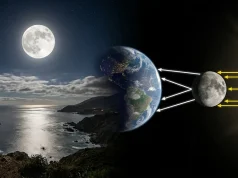
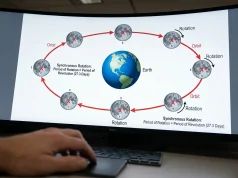
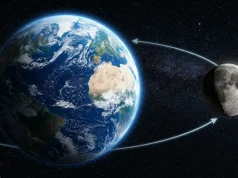
Inquisitive minds frequently look toward the night sky and ask, what is the size of the moon in comparison to the vastness of the cosmos?
This exhaustive research report investigates what is the size of the moon, exploring its physical radius, mass, and volume. By analyzing NASA lunar facts, gravitational dynamics, and historical measurement techniques, this document provides a high-authority overview of the Moon’s scale within the Earth-Moon system and its future role in the Artemis mission.
The Foundational Metrics of Lunar Geometry
The most direct way to answer the query of what is the size of the moon is to examine its linear dimensions. The Moon is not a perfect sphere but rather an oblate spheroid, exhibiting a slight bulge due to tidal forces and its history of rotation. According to NASA lunar facts, the mean lunar radius is approximately 1,737.5 kilometers (1,079.6 miles). When we double this figure to determine the lunar diameter, we arrive at approximately 3,475 kilometers (2,159 miles). This makes our only natural satellite roughly 27.2% the width of the Earth.
To visualize what is the size of the moon, one can imagine the contiguous United States. The distance from the east coast to the west coast is nearly identical to the Moon’s diameter. When considering the equatorial circumference, the Moon measures 10,917 kilometers (6,783.5 miles). These dimensions ensure that the Moon remains the largest satellite in the solar system relative to its parent planet, a key characteristic of the Earth-Moon system.
Determining what is the size of the moon also involves calculating its surface area. The Moon covers approximately 37.9 million square kilometers (14.6 million square miles). While this sounds expansive, it is actually smaller than the total land area of the continent of Asia, which is roughly 44.5 million square kilometers. Despite this, the lunar surface is vast enough to hold all of Europe, China, the United States, Brazil, and South Africa combined. This vast surface area is dominated by two primary types of terrain: the dark, basaltic maria and the lighter, cratered highlands.
Volumetric Capacity and Three-Dimensional Scale
When researchers ask what is the size of the moon in terms of volume, the scale difference between Earth and its satellite becomes even more striking. The volume of the Moon is approximately cubic kilometers (). While this represents a massive amount of rock, it accounts for only about 2% of Earth’s total volume.
The mathematical relationship follows the sphere volume formula:
Using this formula, analysts have determined that it would take approximately 49 to 50 Moons to fill the entire volume of the Earth. This discrepancy highlights that while the Moon is nearly one-third the width of Earth, its three-dimensional presence is much smaller. This second-order insight is vital for understanding the internal mechanics of celestial bodies, as volume directly dictates the heat-retention capabilities and geological longevity of a world.
The Quantitative Essence: Analyzing Moon’s Mass and Density
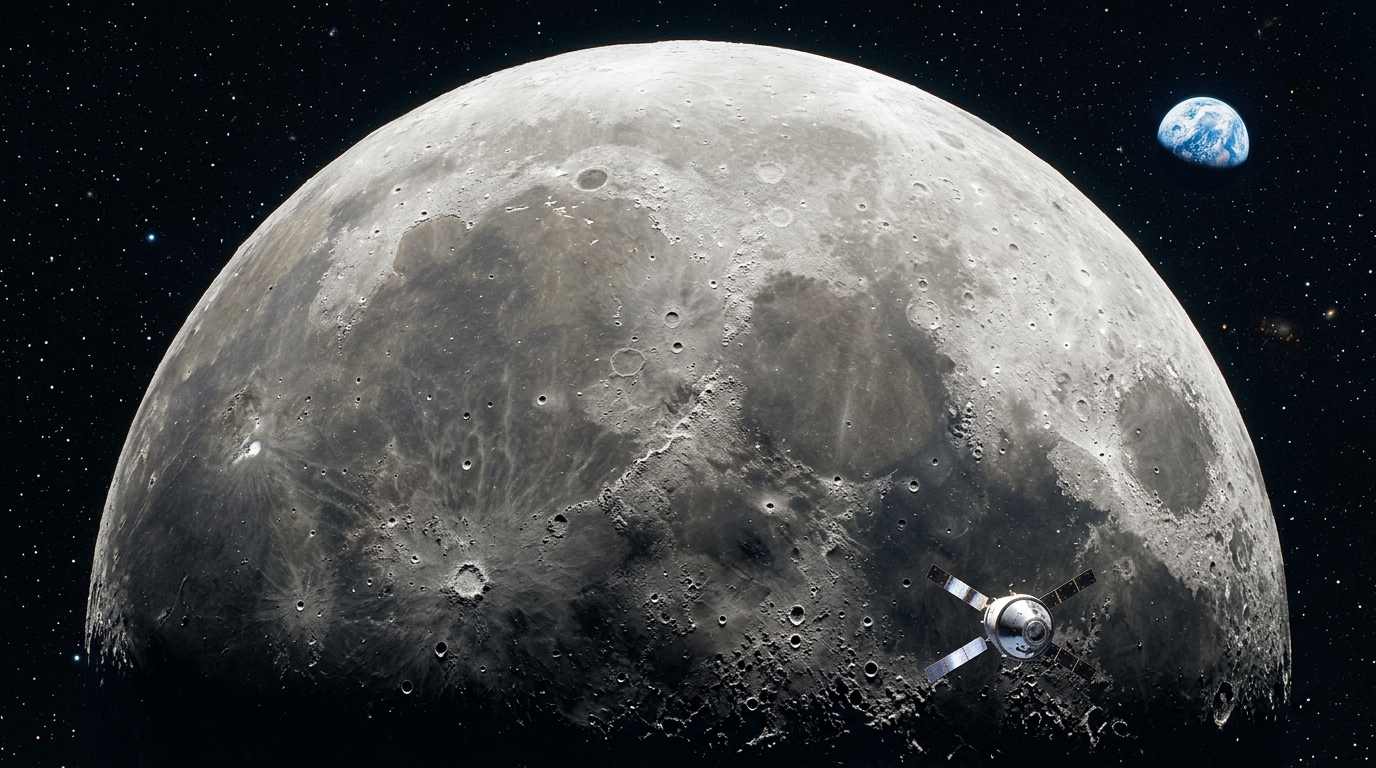
A comprehensive look at what is the size of the moon must transition from physical dimensions to mass and matter. The moon’s mass is approximately kilograms. This weight is roughly 1.2% of Earth’s total mass. Put differently, Earth is about 81 times more massive than its satellite.
The density of the Moon provides clues to its origins. Its mean density is 3.344 grams per cubic centimeter (), which is about 60% of Earth’s density (). This lower density suggests that the Moon lacks a large, iron-rich core similar to Earth’s. Instead, the lunar core is relatively small, with a radius of only about 240 kilometers (149 miles). The core consists of a solid, iron-rich center surrounded by a liquid iron shell.
This specific mass-to-volume ratio creates a surface lunar gravity that is roughly one-sixth (16.6%) of Earth’s gravity. Understanding what is the size of the moon through its gravitational pull is essential for space exploration. At 1.624 , the Moon’s gravity is enough to influence tides on Earth but too weak to hold onto a thick atmosphere, resulting in a thin exosphere where gas molecules rarely collide.
The Earth-Moon Distance and Orbital Influence
Understanding what is the size of the moon requires examining its proximity and its path through space. The lunar orbit is elliptical, which means the Earth-Moon distance is constantly in flux. On average, the Moon orbits at a distance of 384,400 kilometers (238,855 miles) from Earth’s center.
During perigee, the Moon’s closest approach, it comes within approximately 356,400 kilometers. During apogee, its farthest point, it recedes to about 406,700 kilometers. This distance is so vast that one could fit the other seven major planets of the solar system in the space between the Earth and the Moon. A common visualization used to answer what is the size of the moon relative to its distance is that 30 Earth-sized planets could fit between the two bodies.
The gravitational pull of the Moon at this distance is responsible for the rhythmic tides on Earth. Furthermore, the two bodies orbit a common barycenter, which is located about 1,700 kilometers below Earth’s surface, rather than the Moon orbiting Earth’s exact center. Over time, tidal friction is causing the Moon to move away from Earth at a rate of roughly 3.8 centimeters (1.5 inches) per year.
Comparing Solar System Moons: Where Does Our Satellite Rank?
When asking what is the size of the moon, it is important to contextualize its rank among other solar system moons. Our Moon is the fifth-largest natural satellite in the solar system. It is surpassed only by Jupiter’s Ganymede, Callisto, and Io, and Saturn’s Titan.
Despite being fifth in total size, the Moon is the largest satellite in the solar system relative to the size of its parent planet. For instance, while Ganymede is much larger than our Moon, it is tiny compared to the massive planet Jupiter. Our Moon’s 1:4 size ratio with Earth is unique and gives it a disproportionately large influence over its host world. Additionally, the Moon is larger and more massive than any known dwarf planet, including Pluto.
Historical Perspectives: How We Measured the Moon
The journey to discover what is the size of the moon began long before modern spaceflight. The ancient Greeks used ingenuity and geometry to estimate lunar dimensions. Aristarchus of Samos (310–230 BC) used the geometry of a lunar eclipse to determine that the Moon’s distance was much smaller than the Sun’s, and he estimated the Moon’s size by comparing it to the Earth’s shadow.
Later, Hipparchus (190–120 BC) utilized the principle of parallax. By observing a solar eclipse from two different latitudes—the Hellespont and Alexandria—he noted the difference in how much of the Sun was covered. Through these observations, he calculated the Moon’s distance as roughly 30 times Earth’s diameter, a figure that remains remarkably close to the 30.17 value confirmed by modern science.
In the modern era, our understanding of what is the size of the moon has reached millimeter precision. During the Apollo missions, astronauts deployed retroreflectors on the lunar surface. Scientists on Earth now fire lasers at these mirrors and measure the round-trip time of the light pulses. This process, known as Lunar Laser Ranging (LLR), allows us to track the Moon’s position and recession with incredible accuracy, testing Einstein’s theory of general relativity in the process.
Structural Composition: Inside the Lunar Sphere
To truly answer what is the size of the moon, one must look beneath the surface. The Moon is a differentiated body, meaning it has layers of distinct composition.
The lunar core is estimated to be only about 20% of the Moon’s total radius. This is much smaller than Earth’s core, which occupies about 50% of its radius. The lunar interior is composed of:
- Solid Inner Core: A radius of about 240 km (149 miles).
- Liquid Outer Core: A shell roughly 90 km (56 miles) thick.
- Partially Molten Layer: Surrounding the core-mantle boundary.
- Mantle: A thick layer of silicate rock.
- Crust: Composed of oxygen, silicon, magnesium, iron, calcium, and aluminum.
The crust is notably asymmetrical. Data from orbiting spacecraft shows that the crust on the “far side” of the Moon is thicker than on the “near side.” This asymmetry is one of the many mysteries scientists are still investigating as they seek to understand the complete picture of what is the size of the moon and its internal distribution of mass.
The Moon in the Human Eye: Perception vs. Reality
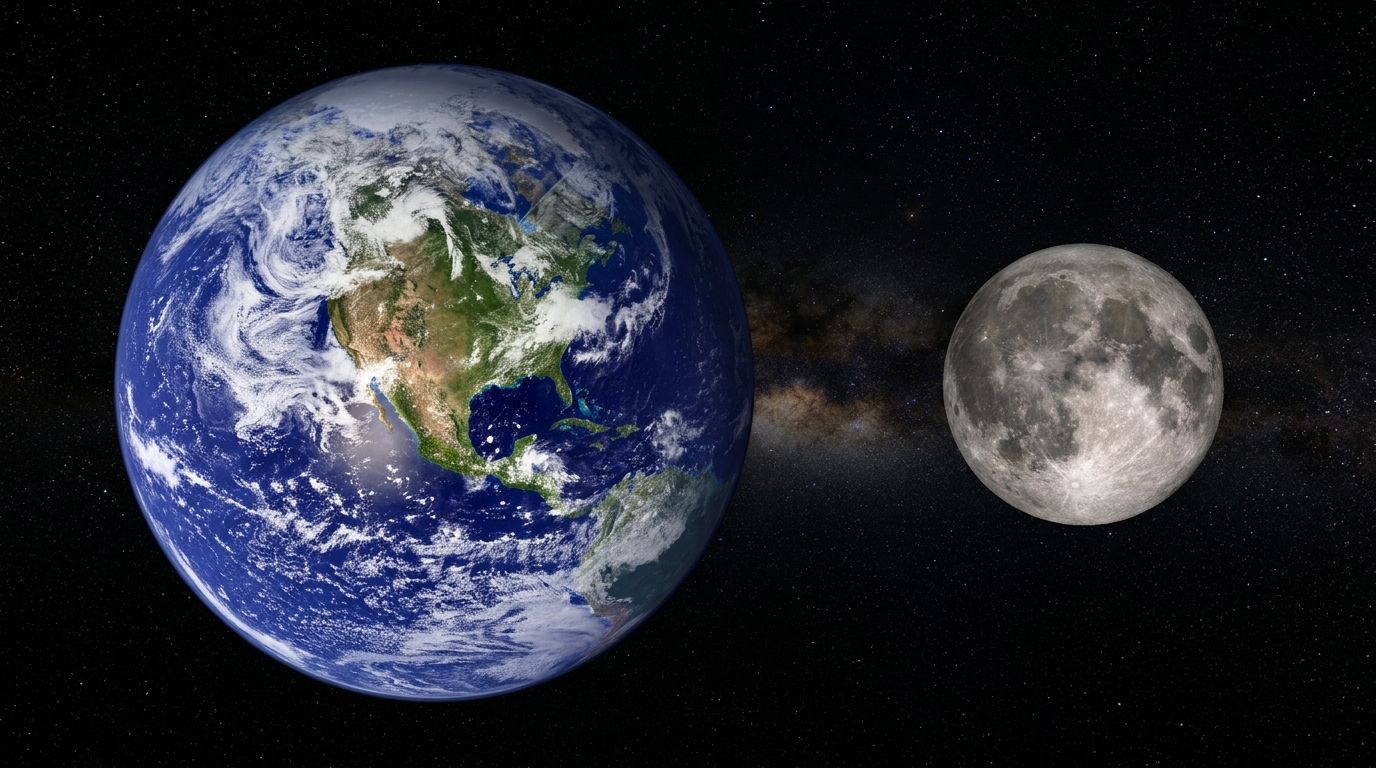
Human perception often skews the answer to what is the size of the moon. This is most evident in two phenomena: the “Moon Illusion” and the supermoon.
The Moon Illusion occurs when the Moon is near the horizon and appears significantly larger than when it is high in the sky. Despite this visual “expansion,” photographs and telescope measurements prove that the Moon’s angular size does not change. The illusion is a result of how the brain processes distances when there are terrestrial objects, like trees or mountains, in the foreground for comparison.
Conversely, a supermoon is a real physical change in apparent size. Because the lunar orbit is not a circle, the Moon is 14% larger in the sky at perigee than at apogee. During these times, the Moon also shines 30% brighter, creating a stunning visual display for observers on Earth.
Another perception-altering fact is the “cosmic coincidence” involving the Sun. The Sun is 400 times wider than the Moon, but it is also 400 times farther away. This creates a situation where both objects appear to be the same size—about half a degree—in our sky. This unique alignment is what allows for the spectacular phenomenon of a total solar eclipse.
Future Foundations: Artemis Mission and Lunar Construction
As we look forward to the Artemis mission, the quest to understand what is the size of the moon shifts from pure science to practical engineering. NASA’s goal is to establish a long-term presence at the lunar South Pole.
The size and gravity of the Moon dictate the architecture of these future bases. Engineers must design habitats that can withstand extreme temperature shifts—ranging from in the sun to in the shade. The low lunar gravity allows for the construction of larger structures than would be possible on Earth, but the lack of an atmosphere means these buildings must be shielded against radiation and micrometeoroids.
The scale of craters on the moon also plays a role. At the South Pole, some craters are so deep that their floors never see sunlight. These “permanently shadowed regions” may harbor vast amounts of water ice. The size of these ice deposits will determine the feasibility of “in-situ resource utilization,” where astronauts harvest water for drinking and oxygen for breathing.
Common Mistakes to Avoid in Lunar Science
When discussing what is the size of the moon, several common errors frequently appear in public discourse. Avoiding these misconceptions is critical for scientific accuracy:
- The “Dark Side” Error: Many people believe the far side of the Moon is permanently dark. In reality, the far side experiences day and night just like the near side; it is simply “far” because we cannot see it from Earth.
- The Atmospheric Myth: While the Moon has an exosphere, it is often said to have “no atmosphere.” Scientifically, it has a very thin layer of gas, but it is a near-vacuum and cannot support life.
- The Distance Underestimation: Most diagrams show the Moon very close to Earth. In reality, you could fit 30 Earths in the space between them.
- Assuming the Moon is a Perfect Sphere: The Moon is an oblate spheroid, and its center of mass is slightly offset from its geometric center.
- Misunderstanding Phases: Moon phases are not caused by Earth’s shadow. They are caused by the angle of sunlight hitting the Moon as it orbits our planet.
Expert Insights: The Moon as a Planetary Laboratory
For planetary geologists, the answer to what is the size of the moon is inseparable from its role as a geological record of the early solar system. Because the Moon is geologically “dead” compared to Earth—lacking plate tectonics and significant erosion—its surface preserves the history of the “Late Heavy Bombardment.”
The size and frequency of craters on the moon allow scientists to calculate the age of surfaces across the solar system. By counting craters in a specific area, researchers can estimate how long that surface has been exposed to space. This makes the Moon a vital laboratory for understanding the violent history that shaped all the rocky celestial bodies in our neighborhood.
Pro Tips for Observing the Moon
If you are interested in verifying what is the size of the moon for yourself, use these tips for better astronomical observation:
- Observe at the Terminator: The “terminator” is the line between day and night on the Moon. This is where shadows are longest, making craters on the moon and mountain ranges stand out in high relief.
- Use the Pinky Rule: At arm’s length, your pinky finger is about 1 degree wide. Since the Moon is 0.5 degrees wide, your pinky can easily cover it.
- Check the Libration: Because of the Moon’s slight “wobble,” or libration, you can actually see about 59% of the surface over time, rather than just 50%.
- Watch for the Earthshine: During a crescent phase, you can often see the “dark” part of the Moon glowing faintly. This is sunlight reflecting off Earth and hitting the Moon—a phenomenon known as Earthshine.
Conclusion: Synthesis of Lunar Scale
In summary, when we ask what is the size of the moon, we are looking at a world that is 3,475 kilometers wide, 81 times less massive than Earth, and possesses only 1/6th of its gravity. It is a world of extremes, from its small lunar core to its vast, airless plains. As our only natural satellite, it remains a cornerstone of human exploration and a beacon for the upcoming Artemis mission. Understanding these dimensions is the first step in appreciating our place in the solar system moons hierarchy and the intricate dance of the Earth-Moon system.
FAQs about the Size and Scale of the Moon
1. What is the size of the moon compared to Earth’s width?
The Moon is approximately 27% the width of Earth. Specifically, its diameter is 3,475 km compared to Earth’s 12,742 km.
2. How many Moons would fit inside the Earth?
Due to the differences in volume, it would take approximately 50 Moons to fill the volume of one Earth.
3. Is the Moon larger than Pluto?
Yes. The Moon’s diameter of 3,475 km is larger than Pluto’s diameter of roughly 2,376 km.
4. How much would a 100 kg person weigh on the Moon?
Because lunar gravity is 1/6th of Earth’s, a person who weighs 100 kg on Earth would weigh approximately 16.6 kg on the Moon.
5. What is the biggest moon in the solar system?
Jupiter’s Ganymede is the largest moon, with a diameter of 5,268 km. Our Moon ranks as the fifth-largest.
6. Does the Moon have a bigger radius than Mercury?
No. Mercury’s radius is approximately 2,440 km, while the Moon’s radius is 1,737.5 km. Mercury is about 1.4 times larger.
7. How far away is the Moon in “Earths”?
The Moon is about 30 Earth-diameters away from our planet on average.
8. What is the total surface area of the Moon?
The surface area is 37.9 million square kilometers, which is slightly less than the area of Asia but more than that of Africa.
9. Why does the Moon look larger during a supermoon?
It looks larger because it is physically closer to Earth at perigee. It can appear 14% larger than at its farthest point (apogee).
10. Is the Moon perfectly round?
No, the Moon is an oblate spheroid with a slight bulge. Its shape is often compared to that of an egg.